
By Jeff Powell, CEO
Elevage Partners | June 29, 2026
I had a professor years ago who liked to say that we get the world we participate in. At the time I thought he was talking about civics. I’ve come to think he was talking about almost everything, including how we invest.
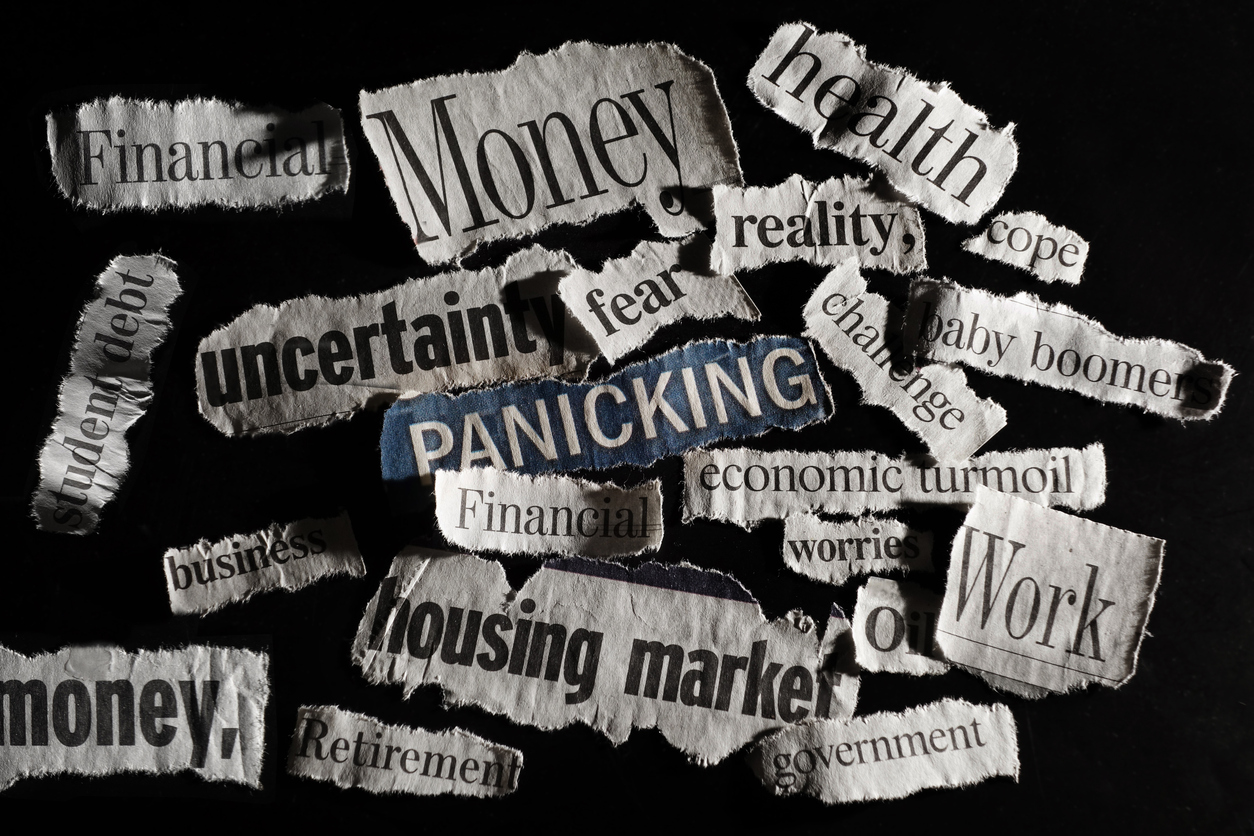
Attention is the product. Every outlet, across the entire spectrum, lives or dies by whether you keep watching, and the single most reliable way to hold a human being’s attention is to make them a little afraid. Calm doesn’t trend. Nuance doesn’t trend. “Everything might fall apart” trends every time. This is how the machine is built, and once you see it you can’t unsee it.
The trouble is that manufactured anxiety doesn’t stay on the screen. It has a cost, and the cost is real money.
The cost you can see
Start with the economy. When uncertainty spikes, people freeze. Businesses postpone hiring and hold off on investment, because waiting feels safer than committing when the ground seems unstable. Households delay the new car, the kitchen, the move. Decades of Federal Reserve and academic research point the same direction: elevated uncertainty reliably foreshadows declines in investment, output, and employment (Source: National Bureau of Economic Research).
That drag isn’t something done to the economy from outside. Rather, it’s millions of people each choosing to wait at the same moment. The collective cost is just personal hesitation, multiplied. Which brings it home.
The cost you can’t see
The more expensive cost never shows up on a statement, because it isn’t only money.
In thirty-plus years of doing this work, the conversations I remember most weren’t about returns. They were the ones where someone admitted they hadn’t been sleeping. In recent years, it’s that they were checking their phone at two in the morning. That the news had been running in the house so constantly the kids had stopped asking about it. Chaos doesn’t only tax your portfolio. It taxes your attention, your evenings, and the people who happen to be in the room with you while you’re somewhere else, scrolling.
There’s no line item for that. But there is one for the financial piece, and understanding it is oddly freeing. When the noise gets loud, the instinct is to do something. Get out. Go to cash. Wait for the dust to settle. It feels like control. The trouble is that the recovery never sends a calendar invite. The best days sit right next to the worst ones, often within two weeks, and the sharpest rebounds tend to arrive while the headlines are still at their ugliest. You only catch them if you were already there. Over the 20 years ending in 2024, missing just the ten best trading days in the S&P 500 would have cut an investor’s annual return nearly in half (Source: J.P. Morgan Asset Management). That’s the real reason you don’t have to time anything, and the reason you can close the laptop. Staying put isn’t passivity, it’s the only way to be there when the market turns. So chaos has a price, and you pay it in two currencies. You don’t have to pay both.
What you can actually control
Here is what that choice comes down to. You cannot control the markets. You certainly cannot control the headlines, and you shouldn’t try. What you can control, every single day, is where you put your attention and whether you let a loud week pull a decision out of you. The anxious response is always available, and there’s an entire industry working hard to keep it within reach. The steady one takes more deliberate effort, but it’s the one that compounds.
Staying steady is not the same as ignoring risk or pretending nothing is wrong. It’s the opposite. It’s doing the work ahead of time so that a loud week doesn’t demand a decision from you in the moment you’re least equipped to make one. Some of that work is specific and unglamorous: owning good businesses without overpaying for them, and building in enough steady income that you’re never forced to sell something in a downturn just to fund your life. But the reason we do it has less to do with the market than you’d think. We do it so that when the world gets loud, your plan is already quiet. So you can close the laptop and go have dinner with the people actually at your table.
That’s the part of this work I care most about. Not beating a number, but helping you build a life the next round of chaos can’t reach.
The world will keep selling chaos, because chaos pays. It just doesn’t have to be paid with your money, your sleep, or your attention. My old professor was right about more than civics: we get the world we participate in. The headlines are one world. The people in the room with you are another. We’d rather help you live in that one.
If this is on your mind, write to us at info@elevagepartners.com. We’d welcome the conversation.